
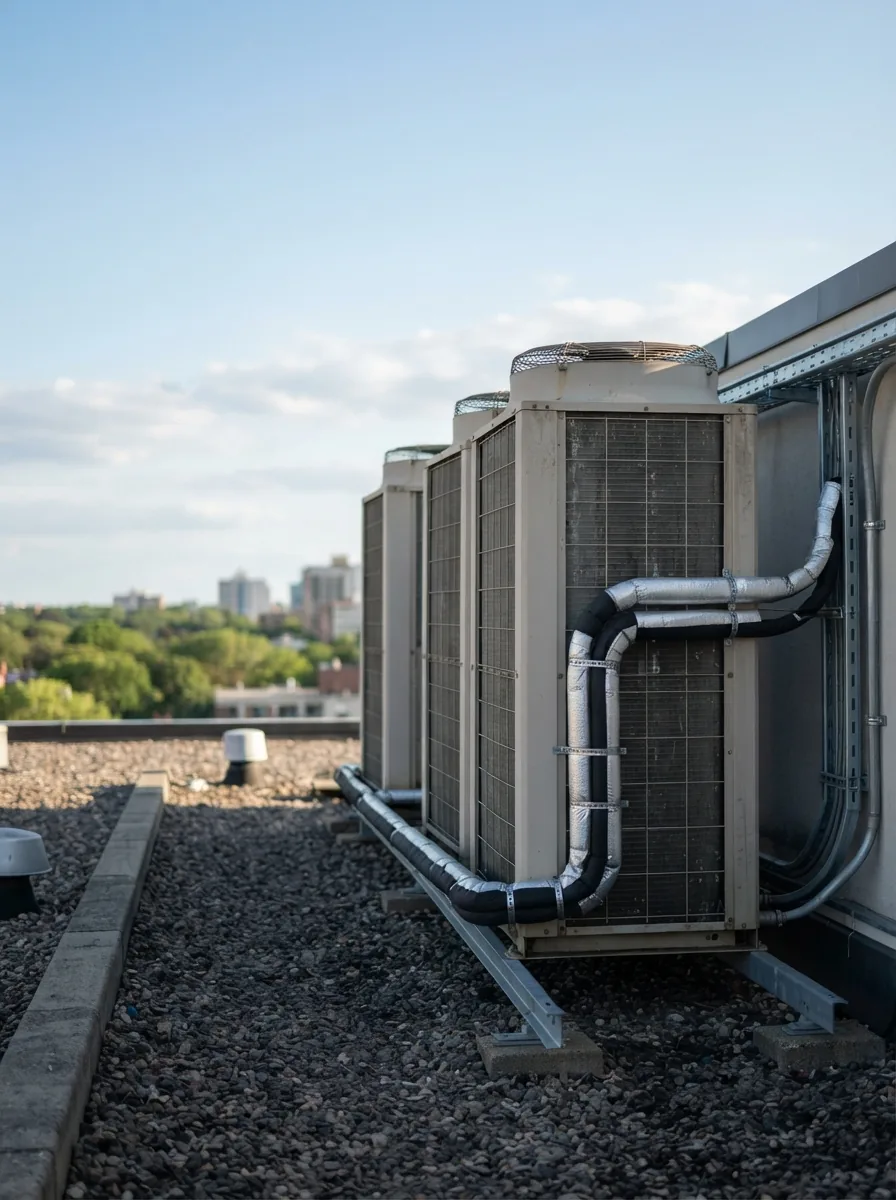
VRV and VRF Air Conditioning Systems in Melbourne, VIC
What is included
What Is Included in Our VRV and VRF Air Conditioning Systems
- We walk the roof, plant room and ceiling voids first, to see where units and pipe routes can physically go.
- Outdoor units are moved into position, set on a base, and given the clearance they need to breathe.
- Refrigerant pipes are run from the outdoor units to branch joints and on to each indoor unit.
- Pipework is hung on supports and insulated, and each run is labelled so it can be traced later.
- Indoor units, whether cassette, ducted or wall mounted, are fitted in each zone, each with a drain that falls away.
- The communication cabling between indoor units, outdoor units and controllers is run and each address is set.
- The pipework is pressure tested and put under vacuum first, which takes longer on big buildings.
- Each zone is run and tuned, then we show your staff the controllers and how to read a fault code.
Why us
Why Choose Us for VRV and VRF Air Conditioning Systems?
Licensed air conditioning and heating specialists
Every VRV and VRF air conditioning systems job runs under VBA licence 115097.
Tested and signed off before we leave
Everything we touch on your VRV and VRF air conditioning systems is tested before we go, you get walked through exactly what was done.
six years on our labour
If the same fault comes back inside six years of us finishing, the return visit is on us.
Local air conditioning and heating specialists, not a call centre
An air conditioning and heating specialist answers the phone and the same faces come back if the job runs over a day.
How the job runs
Why the roof and risers get walked first
The first phone call
Tell us what the building is, how many floors it has, and roughly how many rooms or zones need their own control. We will ask whether the site stays occupied during the work and whether a crane or lift is realistic. Photos of the roof or yard where the outdoor units could go save time.
A quote after the site visit
A system this size is quoted after we have seen the building. The written quote sets out the outdoor units, the number and type of indoor units, the pipe routes and the stages of work. Where we cannot see something, like the inside of a riser, the quote says what is assumed and what would change it.
The works and handover
Work is staged around how the building is used, so noisy or disruptive jobs are planned with you. Outdoor units go in first, then the pipework, then the indoor units zone by zone. At handover we run every zone, and show whoever looks after the building how the controllers work.
Common questions
Frequently Asked Questions
Do you work on homes and businesses?
Both. We install and service heating and cooling in houses, units and townhouses, and in shops, offices and light-industrial sites. The work is the same at its core, but a commercial job is planned around trading hours and a home job around the household.
Which suburbs do you cover?
Melbourne's eastern suburbs, from Glen Waverley, Mulgrave and Rowville across to Blackburn, Camberwell and Balwyn. Each suburb we list has its own page. If yours is not there, ring and ask, because the list is where we work most often rather than a boundary.
Do you do gas heating as well as air conditioning?
Yes. We install and repair ducted gas heating and gas heaters, run gas safety checks with carbon monoxide testing, and do Type A gas fitting for household appliances and Type B gas fitting for commercial and industrial sites.
Do you install hydronic heating?
Yes. That covers panel radiators, underfloor hydronic heating laid in the floor, and the hydronic boiler that feeds them. We also repair and maintain existing hydronic systems, including radiators that stay cold and pumps that make noise.
Can you work on a system that someone else installed?
Yes. Repairs, servicing and cleaning do not depend on who fitted the unit. Read us the make and model from the label on the indoor and outdoor units, and tell us what it is doing, and we will say what we would check first.
What is the difference between a split, a multi-split and a ducted system?
A split system has one indoor unit on a wall serving one room. A multi-split runs several indoor units from one outdoor unit, so each room has its own settings. A ducted system heats and cools the whole house from one unit in the ceiling or underfloor space, through outlets in each room.
What does reverse cycle mean?
A reverse cycle air conditioner can run in both directions. In summer it moves heat out of the room, and in winter it moves heat in from outside. One unit does both jobs, so you do not need a separate heater for the same room.
How often should an air conditioner be serviced?
Filters need cleaning regularly, and the coils, fan and drain tray are checked at a service. We suggest having it done before the season the system works hardest in. A system that has run a long time without a clean is the usual reason for weak airflow and musty smells.
Why does my air conditioner smell musty?
Moisture sits on the coil and in the drain tray, and dust and mould build up there over time. A deep clean takes the indoor unit apart far enough to clean the coil, fan and tray, and applies an antibacterial treatment. A new filter alone does not usually fix it.
What should I do if I smell gas?
Leave the area, do not use switches or flames, get fresh air, and call the gas distributor's emergency line or 000. Do not try to find or fix the leak yourself. Once the area is made safe, ring us and we can look at the appliance or the pipework.
What should I check first if my system stops working?
Check the remote is set to the right mode and temperature, the batteries are in, and the breaker has not tripped. On a gas heater, check the thermostat is set to heat. If none of that helps, ring us with what you saw and we will take it from there.
Can I call outside normal hours?
Yes. The phone is answered 24 hours a day, 7 days a week. We will not promise a time we cannot keep, but you will speak to a person who can talk through what is happening and what to check.
What do you need from me to give a quote?
Which room or building, what the system is doing or what you want it to do, and for a new install the rough size of the room. The model number from the label on an existing unit helps a lot. For some jobs we need to see the space before we can quote.
What if you find something extra once the work starts?
Some things cannot be known until the old unit is off the wall or the ceiling space is open. If we find old pipework, a poor electrical supply or damage, we stop and tell you what it is and what the options are before going further.
What happens at the end of a job?
We test the system in the modes it will use, check the drain and the pipework for leaks, and clean up the area we worked in. Then we show you the remote or the controller and how to set it up, so you know how it works before we go.
Related work
Other jobs we get called out for
air conditioning repairs
Fault finding and repair for split, ducted and multi-split systems that have stopped cooling or heating, leak water or make a noise they should not.
Read moreair conditioning servicing and maintenance
Regular servicing that cleans the filters and coils, checks the refrigerant side and the drain, and keeps the system running as it should.
Read moreair conditioner deep cleaning and antibacterial treatment
A deep clean of the indoor unit, coil, fan and drain tray, with an antibacterial treatment for musty smells and mould on the unit.
Read moreServing Melbourne and The Surrounding Areas
Where we work
Ready when you are
Book VRV and VRF Air Conditioning Systems in Melbourne Today
Send photos of the roof, plant room or yard where the outdoor units could go, and say how many floors the building has. If there is a set of floor plans, a photo of the layout is enough to begin.
0485 093 68924 hours a day, 7 days a week
Not urgent? Send us the job instead