
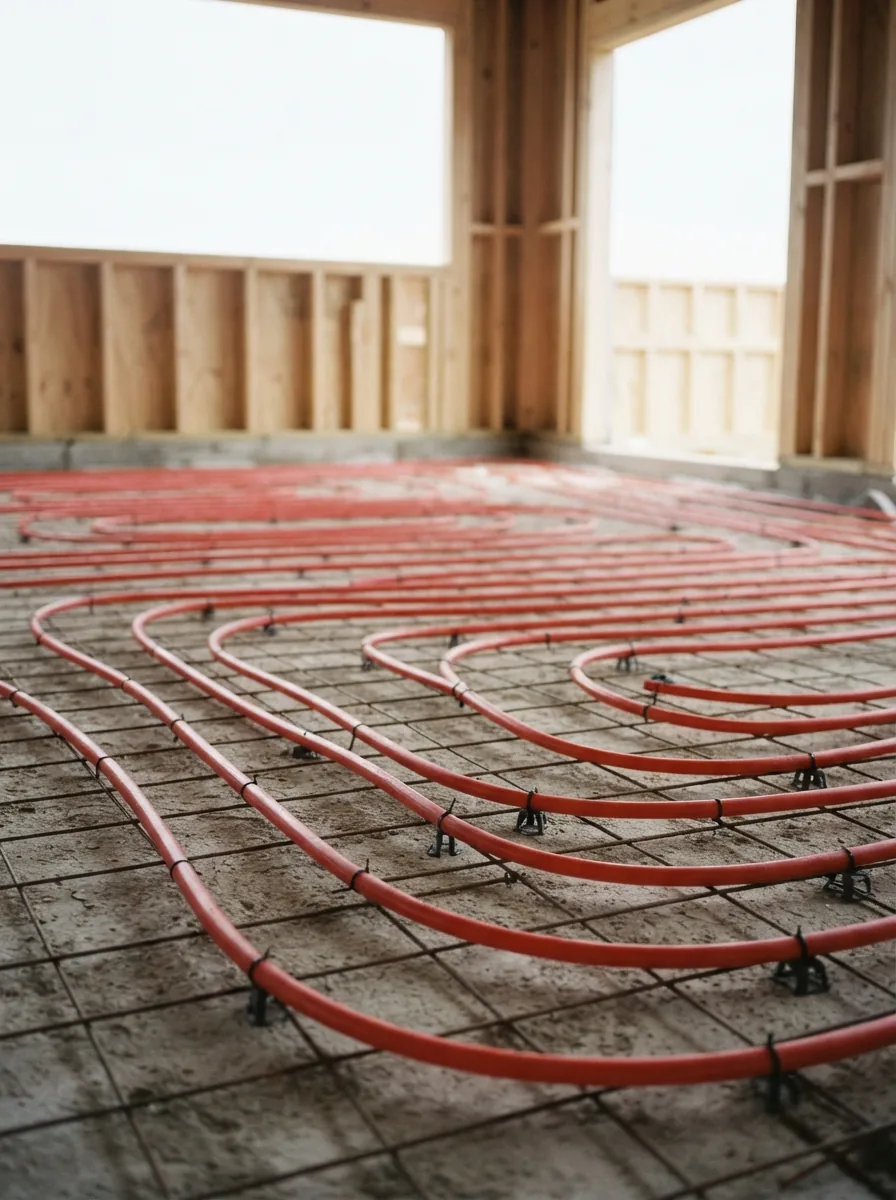
Underfloor Hydronic Heating in Melbourne, VIC
What is included
What Is Included in Our Underfloor Hydronic Heating
- We ask what the floor will be finished with, because tiles, timber and carpet change how loops are laid.
- We mark the loops out on the plan and place the manifold where every loop can reach it.
- Pipe is laid in loops across the slab or under the boards, tied or clipped down at even spacing.
- We pressure test every loop before anything covers it, and leave the pipe under pressure while the floor goes over.
- We stay in touch with the builder, so the pipe is not stepped on or cut during the pour.
- The loops are connected to the manifold, which is run back to the heat source with its pump and controls.
- We fill and flush each loop, bleed out the air and check that water is moving through every one.
- We set the room thermostats, bring the floor up to temperature gradually, and show you how to run it.
Why us
Why Choose Us for Underfloor Hydronic Heating?
Licensed air conditioning and heating specialists
Every underfloor hydronic heating job runs under VBA licence 115097.
Tested and signed off before we leave
Everything we touch on your underfloor hydronic heating is tested before we go, you get walked through exactly what was done.
six years on our labour
If the same fault comes back inside six years of us finishing, the return visit is on us.
Local air conditioning and heating specialists, not a call centre
An air conditioning and heating specialist answers the phone and the same faces come back if the job runs over a day.
How the job runs
Why every loop is tested before covering
Floor stage, plans and timing
We ask whether this is a new build, an extension or a renovation, and what stage the floor is at. Underfloor pipe goes in before the slab is poured or the boards go down, so timing matters. Tell us the floor finish in each room and which rooms you want heated. We will ask for the plans.
A written quote from the plans
We work out the loop lengths and the manifold position from the plans and the floor finish, and the quote is written from that. The heat source feeding the floor is a separate item, and we say whether an existing boiler can run it. If the plans change, the layout and the quote change with them.
Laying, testing and handover
We lay the pipe, pressure test it and leave it under pressure while the floor goes over it. We come back later to connect the manifold, fill and flush the loops and set the thermostats. At handover we show you the controls and explain why a heated floor warms up slowly, so the first cold morning is no surprise.
Common questions
Frequently Asked Questions
Do you work on homes and businesses?
Both. We install and service heating and cooling in houses, units and townhouses, and in shops, offices and light-industrial sites. The work is the same at its core, but a commercial job is planned around trading hours and a home job around the household.
Which suburbs do you cover?
Melbourne's eastern suburbs, from Glen Waverley, Mulgrave and Rowville across to Blackburn, Camberwell and Balwyn. Each suburb we list has its own page. If yours is not there, ring and ask, because the list is where we work most often rather than a boundary.
Do you do gas heating as well as air conditioning?
Yes. We install and repair ducted gas heating and gas heaters, run gas safety checks with carbon monoxide testing, and do Type A gas fitting for household appliances and Type B gas fitting for commercial and industrial sites.
Do you install hydronic heating?
Yes. That covers panel radiators, underfloor hydronic heating laid in the floor, and the hydronic boiler that feeds them. We also repair and maintain existing hydronic systems, including radiators that stay cold and pumps that make noise.
Can you work on a system that someone else installed?
Yes. Repairs, servicing and cleaning do not depend on who fitted the unit. Read us the make and model from the label on the indoor and outdoor units, and tell us what it is doing, and we will say what we would check first.
What is the difference between a split, a multi-split and a ducted system?
A split system has one indoor unit on a wall serving one room. A multi-split runs several indoor units from one outdoor unit, so each room has its own settings. A ducted system heats and cools the whole house from one unit in the ceiling or underfloor space, through outlets in each room.
What does reverse cycle mean?
A reverse cycle air conditioner can run in both directions. In summer it moves heat out of the room, and in winter it moves heat in from outside. One unit does both jobs, so you do not need a separate heater for the same room.
How often should an air conditioner be serviced?
Filters need cleaning regularly, and the coils, fan and drain tray are checked at a service. We suggest having it done before the season the system works hardest in. A system that has run a long time without a clean is the usual reason for weak airflow and musty smells.
Why does my air conditioner smell musty?
Moisture sits on the coil and in the drain tray, and dust and mould build up there over time. A deep clean takes the indoor unit apart far enough to clean the coil, fan and tray, and applies an antibacterial treatment. A new filter alone does not usually fix it.
What should I do if I smell gas?
Leave the area, do not use switches or flames, get fresh air, and call the gas distributor's emergency line or 000. Do not try to find or fix the leak yourself. Once the area is made safe, ring us and we can look at the appliance or the pipework.
What should I check first if my system stops working?
Check the remote is set to the right mode and temperature, the batteries are in, and the breaker has not tripped. On a gas heater, check the thermostat is set to heat. If none of that helps, ring us with what you saw and we will take it from there.
Can I call outside normal hours?
Yes. The phone is answered 24 hours a day, 7 days a week. We will not promise a time we cannot keep, but you will speak to a person who can talk through what is happening and what to check.
What do you need from me to give a quote?
Which room or building, what the system is doing or what you want it to do, and for a new install the rough size of the room. The model number from the label on an existing unit helps a lot. For some jobs we need to see the space before we can quote.
What if you find something extra once the work starts?
Some things cannot be known until the old unit is off the wall or the ceiling space is open. If we find old pipework, a poor electrical supply or damage, we stop and tell you what it is and what the options are before going further.
What happens at the end of a job?
We test the system in the modes it will use, check the drain and the pipework for leaks, and clean up the area we worked in. Then we show you the remote or the controller and how to set it up, so you know how it works before we go.
Related work
Other jobs we get called out for
heat pump hot water system installation
Heat pump hot water systems that make hot water by moving heat out of the air, installed with the plumbing, power and condensate drain sorted.
Read moreheat pump hot water repairs and servicing
Repairs and servicing for heat pump hot water systems that run cold, trip out, make noise or stop heating the tank.
Read moretype A gas fitting and appliance servicing
Gas fitting for household appliances, covering new connections, replacements, relocations and servicing of cooktops, heaters and hot water units.
Read moreServing Melbourne and The Surrounding Areas
Where we work
Ready when you are
Book Underfloor Hydronic Heating in Melbourne Today
Send us the floor plan, or a photo of it, with the rooms you want heated marked on it. Tell us what the floor finish will be in each room. That lets us say whether slab or subfloor loops suit the job.
0485 093 68924 hours a day, 7 days a week
Not urgent? Send us the job instead